The research behind our Sensitive Skin Moisturiser
What sensitive skin is, why fragrance is the first thing to leave out, what each of the 23 ingredients does, and what the research does and doesn't prove.
Most people who say they have sensitive skin have spent money on products that stung. The usual response from the beauty industry is to add something soothing. Our response is to take things out: no fragrance, no essential oils, no strong actives, and a short list of ingredients that help skin hold water.
This guide explains what sensitive skin is, why we built the moisturiser the way we did, and what the research on each ingredient shows. If you only want the product, the moisturiser page has everything. If your skin is dry rather than reactive, read rich cream or light moisturiser? And if you want to know what the words on labels mean, what "fragrance-free" really means covers it.
01What "sensitive skin" means
For a long time "sensitive skin" was a marketing phrase with no agreed meaning. An international group of skin specialists has since agreed a definition, published in 2017, and it is more precise than most people expect.
Definition of sensitive skin
Evidence: expert consensus- Misery L., Ständer S., Szepietowski J.C., et al. Definition of sensitive skin: an expert position paper from the special interest group on sensitive skin of the International Forum for the Study of Itch. Acta Derm Venereol 97(1):4–6, 2017. Read the source
Two things follow from this. First, sensitive skin is about how skin feels as much as how it looks: many people with sensitive skin have no visible redness at all. Second, it is separate from skin diseases such as eczema, rosacea or allergic contact dermatitis, which can look similar and need their own care. If your face is red for weeks, flushes easily or has bumps, see a doctor, because rosacea is common and a moisturiser alone won't address it.
02How common it is
Sensitive skin
Evidence: meta-analysis of surveys- Chen W., Dai R., Li L. The prevalence of self-declared sensitive skin: a systematic review and meta-analysis. J Eur Acad Dermatol Venereol 34(8):1779–1788, 2020. Read the source
If you think of your skin as sensitive, you are in the majority. That is partly why the phrase is on so many labels, and why it pays to look past it to the ingredient list.
03Why fragrance is the first thing to leave out
Stinging and burning have many triggers, and most of them are individual. Allergy is different: it is a specific immune reaction to a specific substance, and once you have it, it tends to last. Fragrance ingredients are among the most frequent causes of allergy to cosmetics.
Fragrance allergy
Evidence: large population study- Diepgen T.L., Ofenloch R., Bruze M., et al. Prevalence of fragrance contact allergy in the general population of five European countries: a cross-sectional study. Br J Dermatol 173(6):1411–1419, 2015. Read the source
Around two in a hundred adults may sound small. Applied to a face cream that is used twice a day for years, on the skin people most often describe as sensitive, it is enough to justify leaving the perfume out. There is also no benefit to your skin from perfume in a moisturiser. It is there for the experience of using it.
"Fragrance-free" doesn't always mean it
Fragrance-free labels
Evidence: product survey- Xu S., Kwa M., Lohman M.E., Evers-Meltzer R., Silverberg J.I. Consumer preferences, product characteristics, and potentially allergenic ingredients in best-selling moisturizers. JAMA Dermatol 153(11):1099–1105, 2017. Read the source
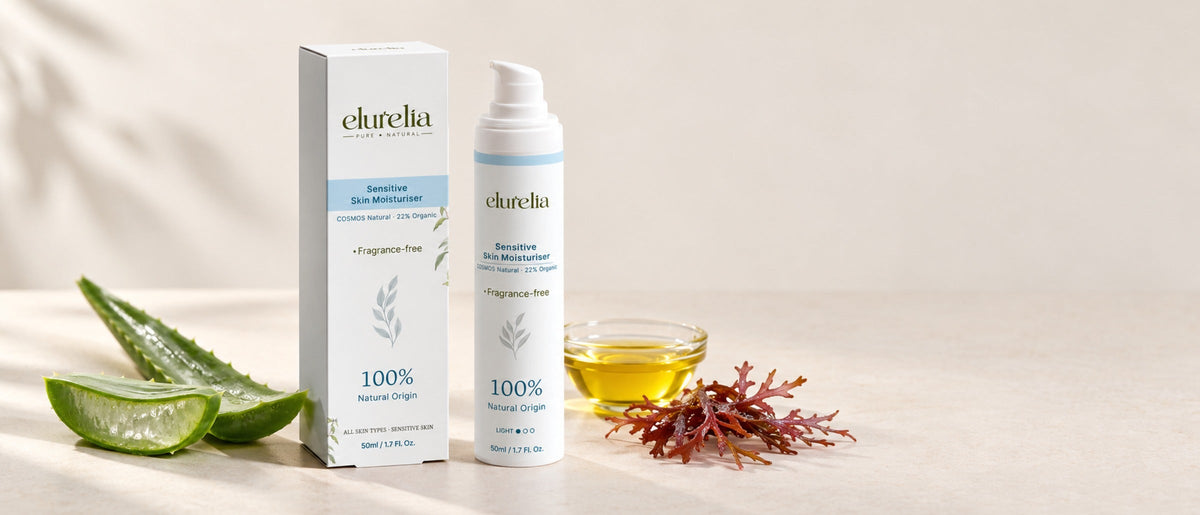
This is why we name every ingredient and say which ones have a scent of their own. This moisturiser contains no Parfum, no essential oils and nothing from the EU fragrance allergen list, including the expanded list that has applied to new products since 31 July 2026. Its plant ingredients are aloe, jojoba, bush mango butter and a red algae extract.
04What a moisturiser for sensitive skin needs
There is no single ingredient that makes a moisturiser suitable for sensitive skin. There are, however, sensible rules, and we built the formula around them.
| Rule | Why | In this moisturiser |
|---|---|---|
| No fragrance or essential oils | Fragrance is a common cause of allergy to cosmetics | None, 0 declared allergens |
| Humectants to hold water | Dehydrated skin feels tight and more reactive | Organic aloe juice, glycerin, sodium PCA, two forms of hyaluronic acid |
| Light emollients | Soften without a heavy film | Organic jojoba oil, coco-caprylate, isoamyl laurate, caprylic/capric triglyceride |
| No strong actives | Acids, retinoids and high-strength vitamin C sting sensitive skin | None |
| A short, readable list | Fewer ingredients to rule in or out | 23 ingredients, all named |
05Glycerin: second on the list
Glycerin
Evidence: review- Fluhr J.W., Darlenski R., Surber C. Glycerol and the skin: holistic approach to its origin and functions. Br J Dermatol 159(1):23–34, 2008.
Glycerin is the workhorse of this formula. It is cheap, well studied and well tolerated, and there is good evidence behind it in general. In one trial in the Cochrane review of moisturisers for eczema, more people using a glycerin moisturiser noticed their skin improve than people using the same cream without glycerin.
06Aloe leaf juice: the base
Organic aloe leaf juice is the first ingredient, which means it is the largest part of the formula, larger than the water further down. Aloe gel is mostly water with sugars, including polysaccharides that hold water on the skin.
Aloe vera
Evidence: small human study- Dal'Belo S.E., Gaspar L.R., Maia Campos P.M. Moisturizing effect of cosmetic formulations containing Aloe vera extract in different concentrations assessed by skin bioengineering techniques. Skin Res Technol 12(4):241–246, 2006. Read the source
07Sodium PCA: part of the skin's own moisturiser
Sodium PCA is seventh on the list. PCA (pyrrolidone carboxylic acid) is the largest single part of the skin's natural moisturising factor, the mix of small molecules that keeps the outer layer supple. Adding it to a cream tops up something the skin already uses.
Sodium PCA
Evidence: older review- Clar E.J., Fourtanier A. Pyrrolidone carboxylic acid and the skin. Int J Cosmet Sci 3(3):101–113, 1981.
08Hyaluronic acid: two forms, near the end
The moisturiser contains sodium hyaluronate, eighteenth of 23, and hydrolysed hyaluronic acid, last. Hyaluronic acid holds a great deal of water, and different molecular sizes behave differently on the skin: large ones stay on the surface and form a film, smaller ones get further into the outer layer.
Hyaluronic acid
Evidence: controlled human study, different cream- Pavicic T., Gauglitz G.G., Lersch P., et al. Efficacy of cream-based novel formulations of hyaluronic acid of different molecular weights in anti-wrinkle treatment. J Drugs Dermatol 10(9):990–1000, 2011. Read the source
09Jojoba oil and the light emollients
Organic jojoba seed oil is third on the list. Strictly it is a liquid wax, and it resembles the wax esters in the skin's own oil. It softens without feeling heavy, which suits a light moisturiser.
Jojoba oil
Evidence: review- Pazyar N., Yaghoobi R., Ghassemi M.R., et al. Jojoba in dermatology: a succinct review. G Ital Dermatol Venereol 148(6):687–691, 2013. Read the source
Around it sit three light, plant-derived emollients: coco-caprylate, isoamyl laurate and caprylic/capric triglyceride. They are the reason the cream spreads easily and doesn't feel greasy. They have no special research behind them because they don't need it: they are well-established, well-tolerated cosmetic oils.
10Red algae and bush mango butter
Two ingredients in the formula have no human research that we could find. Hydrolysed red algae extract (listed as Hydrolyzed Rhodophyceae Extract) is a seaweed extract used for its film-forming and hydrating feel. Bush mango kernel butter (Irvingia Gabonensis Kernel Butter) is a light plant butter from West Africa that adds a little richness.
We searched for peer-reviewed trials of both on human skin and found none. That doesn't make them bad ingredients; it means we can't tell you what, if anything, they add beyond feel. We'd rather say so than borrow research on other seaweeds or butters.
11Does the brand of moisturiser matter?
Moisturisers in general
Evidence: Cochrane review of 77 trials- van Zuuren E.J., Fedorowicz Z., Christensen R., Lavrijsen A., Arents B.W.M. Emollients and moisturisers for eczema. Cochrane Database Syst Rev 2:CD012119, 2017. Read the source
For sensitive skin this is useful in two ways. It means a plain, well-made moisturiser is a reasonable choice, and it means the best moisturiser for you is the one your skin tolerates and you use every day. That is the case we make for this one: fewer triggers, a short readable list, and a light feel that makes twice-a-day use easy.
12What we don't claim: redness and "calming"
Many moisturisers for sensitive skin claim to reduce redness or calm irritation. We don't, because none of the ingredients in this formula has good evidence for reducing redness when used in a cream like ours. A well-hydrated skin barrier may feel more comfortable and react less, and that is as far as we go.
Persistent redness is worth taking seriously. Rosacea, eczema and allergic contact dermatitis can all look like "sensitive skin", and all of them are better managed with a diagnosis. If redness lasts more than a few weeks, flares with heat, alcohol or spicy food, or comes with bumps or scaling, see a doctor.
13How to patch test a new moisturiser
If your skin reacts easily, try any new product on a small area first. Apply a small amount to the inner forearm, or just below the ear, once or twice a day for five days, in the same place each time. If there is no redness, itching or stinging, try it on one cheek for a few days before using it all over.
A patch test isn't a guarantee, but it catches most problems before they reach your whole face. If you do react, stop using the product and note the ingredient list: over time, the ingredients common to products that bother you are the ones to avoid.
14What COSMOS Organic means here
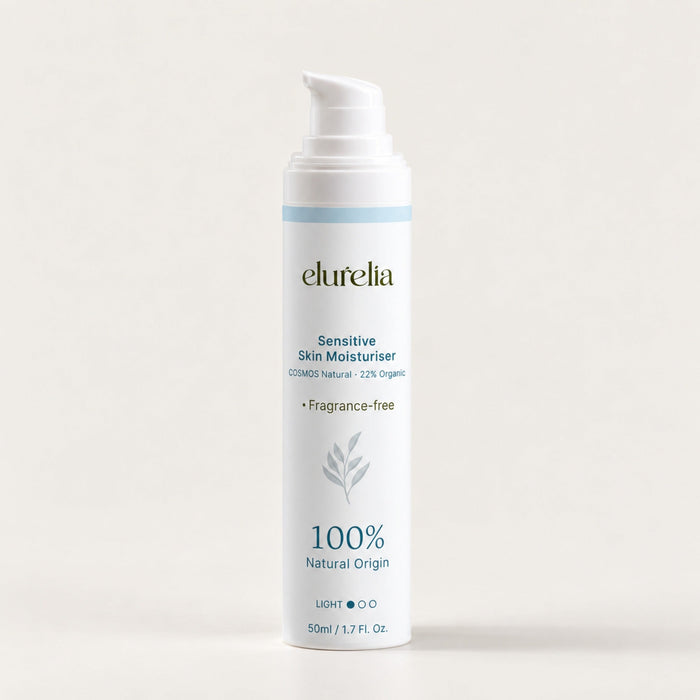
The moisturiser is certified COSMOS Organic by Ecocert. Its natural-origin content is 100% and its organic content is 22%, both calculated to the COSMOS standard. The organic aloe juice and organic jojoba oil are the organic ingredients. COSMOS Organic sets minimum organic content for the product and for its plant ingredients; it doesn't make a product suitable for sensitive skin on its own, which is why we also look at what is left out.
15How to use it, and how long it lasts
Cleanse gently with lukewarm water, then pat dry. One pump is enough for the face; a second covers the neck. Smooth it in without rubbing. In the morning, let it sink in for a minute, then apply sunscreen. It has no SPF.
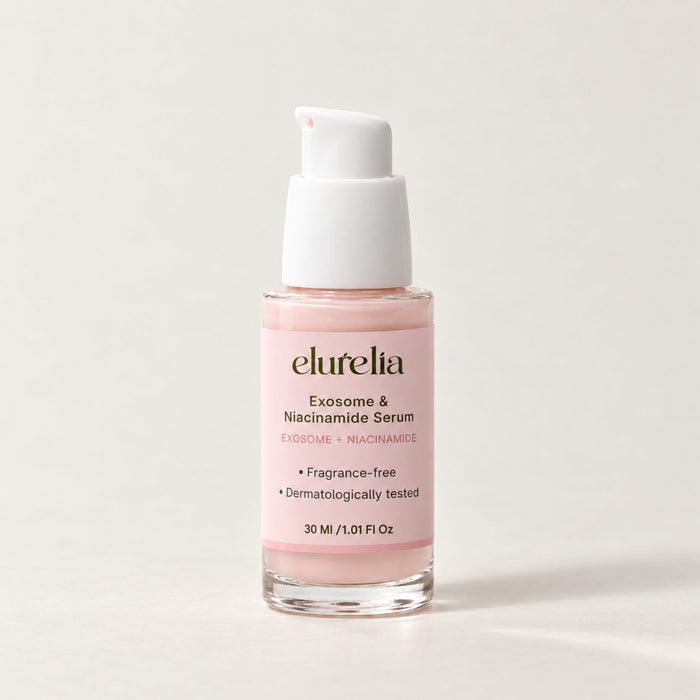
For a simple fragrance-free routine: our Fragrance-Free Niacinamide Serum before the moisturiser if you want an active, and our Fragrance-Free Biphasic Make-up Remover for eye make-up. Our guide to a simple routine for sensitive skin has more. Used morning and evening, a 50 ml bottle lasts around two months.
16Who it suits, and who should skip it
It suits you if your skin stings, itches or reddens with many products; you want a moisturiser with no fragrance and no declared allergens; your skin feels tight or dehydrated but you dislike rich creams; or you want a simple moisturiser for morning and evening.
Skip it, or check first, if your skin is very dry or flaky (our Fragrance-Free Rich Cream suits it better); you want an active for lines or dark spots; you have a skin condition that is flaring, in which case see a doctor or pharmacist; or you want SPF, which it doesn't have.
17What it adds up to
This is a plain, light, fragrance-free moisturiser built on humectants with good general evidence: glycerin, aloe and sodium PCA, with jojoba and light emollients to soften. Its strongest feature is what it leaves out. Its weakest point is that two of its ingredients have no human research we could find, and that it hasn't been tested as a finished product in a published study.
If you want a moisturiser that doesn't add to the list of things your skin might react to, it is a sensible choice. The product page has the full formula, and if your skin is drier than it is sensitive, rich cream or light moisturiser? will help you choose.
18Your questions, answered
What is the best moisturiser for sensitive skin?
The one your skin tolerates and you use every day. Start with one that has no fragrance or essential oils and a short ingredient list, and patch test it first.
Is this moisturiser fragrance-free?
Yes. No Parfum, no essential oils and no ingredient from the EU fragrance allergen list.
Does it reduce redness?
We don't claim it does. If you have persistent redness, see a doctor: it may be rosacea.
What does sensitive skin mean?
Unpleasant sensations such as stinging, burning or itching in response to things that shouldn't cause them, not explained by a skin disease. The skin may look normal or red.
Can I use it with niacinamide?
Yes. Apply the serum first and the moisturiser on top.
Is it enough for dry skin?
For normal, combination and dehydrated skin, usually. For very dry skin, a richer cream may suit you better.
Is it vegan?
Yes, and gluten free.
Does the 60-Day Promise apply?
Yes, on your first order, conditions apply. The full terms are on our 60-Day Promise page.
This article is for general information and isn't medical advice. Cosmetic products: all claims describe the appearance and feel of skin.