Exosomes in skincare: what they are and how to check a label
What the word means, what the research shows so far, why the EU bans one kind, and how to tell from an ingredient list what you are actually buying.

Exosomes are the newest big word in skincare. They arrived from medical research, moved into clinic treatments and then into serums, usually with promises of "regeneration" and "cell communication". Some of the science behind them is genuinely interesting. Much of the marketing is ahead of it.
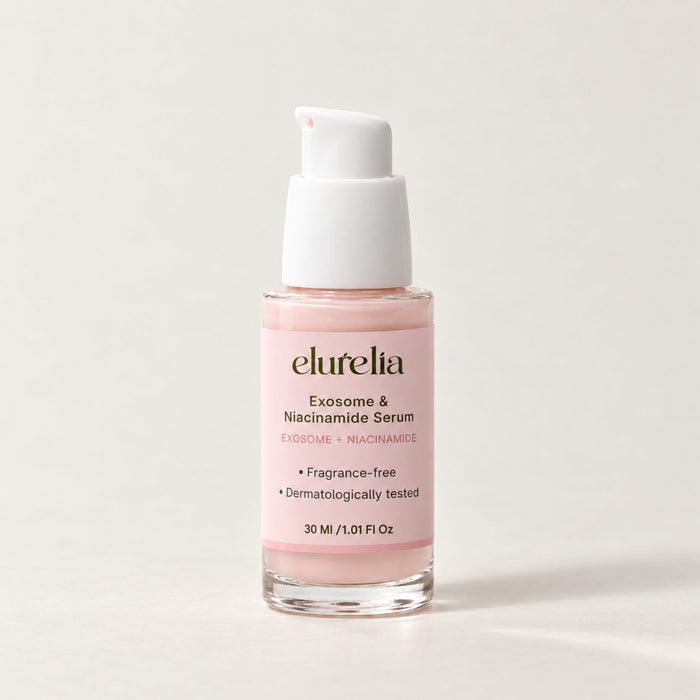
We make a serum that our production partner calls an exosome serum, and we chose not to use the word. This guide explains what exosomes are and why we made that decision. If you only want the product, our Fragrance-Free Niacinamide Serum page has everything.
01What exosomes are
Almost every cell releases tiny bubbles wrapped in the same fatty material as its own outer membrane. The smallest are called exosomes, typically 30 to 150 nanometres across, a few hundred times smaller than a skin cell. Inside they carry proteins, fats and fragments of genetic material. Other cells can take them up, which is why researchers describe them as a way for cells to send messages.
Scientists increasingly use the broader term extracellular vesicles, because it is hard to prove which kind of vesicle a sample contains. Plants release similar vesicles, often called plant-derived extracellular vesicles or exosome-like nanovesicles. Grapes, apples, citrus, ginger and ginseng have all been studied.
02Human exosomes: not allowed in EU cosmetics
Some clinic treatments outside the EU use vesicles taken from human stem cells. In the EU, the Cosmetics Regulation prohibits cells, tissues and products of human origin in cosmetic products, which rules out human-derived exosomes. Any EU cosmetic that contains vesicles should be using a plant, microbial or other non-human source.
Outside cosmetics, human-derived vesicles are regulated as medicines, with a very different level of testing. If a product sold as a cosmetic implies human stem-cell exosomes, take that as a warning sign.
- Regulation (EC) No 1223/2009 of the European Parliament and of the Council on cosmetic products, Annex II (list of substances prohibited in cosmetic products). Read the source
03What the research on plant vesicles shows so far
Most plant-vesicle research is still in cells and animals. Human studies on skin are few and small. One of the better-reported examples is a study of apple-derived vesicles.
Apple-derived vesicles on skin
Evidence: human trial- Sileo et al. Dermatologically tested apple-derived extracellular vesicles: safety, anti-aging, and soothing benefits for skin health. J Cosmet Dermatol 24:e70254, 2025. Read the source
A result without a placebo can't separate the vesicles from the cream around them, or from the simple effect of moisturising every day for two months. That doesn't make the result wrong. It makes it early.
04How to check a label
The ingredient list is the only part of the pack that is regulated in detail. Here is what to look for.
| What the list says | What it usually means |
|---|---|
| An ingredient naming exosomes or extracellular vesicles | The vesicles are declared as an ingredient in their own right |
| A fruit or plant extract plus phospholipids or lecithin | Could be plant vesicles, or an extract carried in liposomes. The label can't tell you which |
| A ferment or ferment lysate | Material from microbial fermentation. Not the same as isolated vesicles |
| Callus or cell culture extract | Material from plant cells grown in a lab. Not isolated vesicles |
| Nothing like the above | The word on the front isn't backed by the ingredient list |
Liposomes are worth a word. They are man-made bubbles of phospholipids, the same family of fats that forms cell membranes and vesicle walls. They have been used for decades to carry ingredients in skincare and medicine. They are useful and well understood, and they are not exosomes.
05Why we left "exosome" off our serum
Our Fragrance-Free Niacinamide Serum is sold by our production partner as an "exosome and niacinamide serum", powered by "apple extract-infused exosomes". Its ingredient list shows Pyrus Malus Fruit Extract (apple fruit extract) and Phospholipids. That is the second row of the table above: consistent with apple vesicles, and equally consistent with apple extract in liposomes.
We can't check which it is from the label, so we named the serum after what we can verify: niacinamide, which has good human evidence, and no fragrance at all. We have asked for the raw-material specification and will say so on the page if it confirms apple vesicles. The research behind the serum goes through every ingredient.
06Five questions to ask any exosome product
- Which ingredient on the list is the exosome, and what is its full ingredient name?
- What is the source: plant, microbial or other? (In the EU it shouldn't be human.)
- How were the vesicles isolated and measured? Size and count, not just "exosome technology".
- What percentage is used?
- Was the finished product tested against a placebo, and on how many people?
Most brands won't answer all five. The ones that can are worth taking more seriously.
07Quick answers
Are exosomes in skincare real?
Plant-derived vesicles are real and are being studied, but human evidence on skin is early and small. Many products using the word don't name vesicles on their ingredient list.
Are exosomes safe in cosmetics?
Plant-derived vesicles used so far have passed standard safety tests in published studies. Human-derived exosomes can't be used in EU cosmetics.
What is the difference between exosomes and liposomes?
Exosomes are released by living cells. Liposomes are man-made bubbles of phospholipids used to carry ingredients.
Does your serum contain exosomes?
We can't confirm it from the label, so we don't claim it. We are waiting for the raw-material data.
This article is for general information and isn't medical advice. Cosmetic products: all claims describe the appearance and feel of skin.