The research behind our Biphasic Make-up Remover
How a two-phase remover dissolves waterproof make-up, what each of its 23 ingredients does, why we made it without fragrance, and what the research does and doesn't prove.

A make-up remover is the product people think about least and use most carelessly. It goes on the thinnest skin of the face, often with a lot of rubbing, at the end of a long day. For something used so close to the eyes every evening, the ingredient list deserves more attention than it usually gets.
This guide goes through our Fragrance-Free Biphasic Make-up Remover ingredient by ingredient. If you only want the product, the remover page has everything in one place. If you are choosing between this and micellar water, this comparison helps. If waterproof mascara is your battle, our step-by-step method will help more than any product on its own.
01Why a make-up remover needs two phases
Make-up is designed to stay put. Waterproof mascara holds its colour with waxes, oils and film-forming polymers that repel water. Long-wear foundation and lipstick use similar ingredients. That is why splashing water or wiping with a water-based product often leaves mascara behind, and why people end up rubbing.
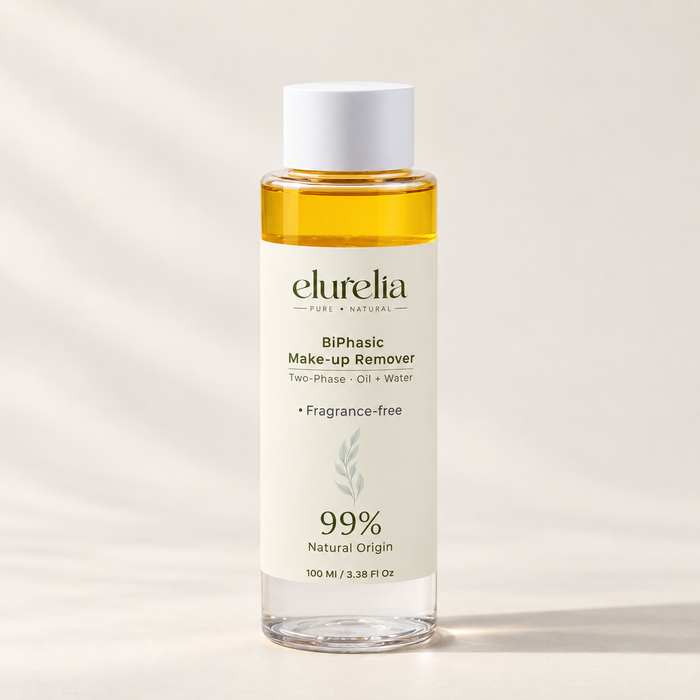
Oil dissolves oil and wax. That is the whole principle behind oil cleansers, cleansing balms and two-phase removers. A two-phase remover puts a light oil and a water-based lotion in the same bottle. The oil loosens the make-up; the water phase takes away the greasy feeling so skin feels fresh rather than coated.
The two layers sit separately because oil and water don't mix on their own. There is no emulsifier holding them together, which is the point: shaking mixes them for a few seconds, long enough to soak a pad, and then they separate again. A little salt in the water phase helps them part cleanly.
| Phase | What it does | In this remover |
|---|---|---|
| Oil (top, golden) | Dissolves waxes and oils in make-up | Isoamyl laurate, coco-caprylate/caprate, coconut alkanes, organic sunflower oil |
| Water (bottom, clear) | Refreshes skin and carries water-soluble ingredients | Organic aloe juice, glycerin, butylene glycol, salt |
| Small extras | Plant extracts, preservation and pH | Camomile, sea buckthorn, raspberry, paprika, rosemary, vitamin E |
02Why the eye area needs care
The skin of the eyelids is the thinnest on the body, and it moves thousands of times a day. It reacts more easily than the rest of the face, and when it does, the redness and swelling are hard to miss. Rubbing makes things worse: it adds friction to skin that is already delicate, pulls at lashes, and pushes product towards the eye.
What causes eyelid dermatitis
Evidence: review- Huang C.X., Yiannias J.A., Killian J.M., Shen J.F. Seven common allergen groups causing eyelid dermatitis: education and avoidance strategies. Clin Ophthalmol 15:1477–1490, 2021. Read the source
Two of those groups, fragrances and preservatives, are in many eye make-up removers. This remover contains no fragrance at all. Its preservatives are sodium benzoate and potassium sorbate, with sodium levulinate; it doesn't contain methylisothiazolinone or benzalkonium chloride, the two preservatives the review singles out. It does contain a small amount of a surfactant, which we cover below.
03Why we made it fragrance-free
Fragrance adds nothing to how well a remover works. It is there for the experience, and it goes on the most reactive skin of the face every evening. The EU's scientific committee estimates that 1% to 3% of Europeans are allergic to some fragrance ingredients.
This remover has no Parfum, no essential oils and no ingredient from the EU fragrance allergen list, including the expanded list that has applied since 31 July 2026. It is our second fragrance-free product, after our Fragrance-Free Niacinamide Serum. You may notice a faint natural smell from the camomile, sea buckthorn and fruit extracts. Nothing is added to create or hide it.
- Scientific Committee on Consumer Safety. Fragrance allergens in cosmetic products: citizens' summary. European Commission, 2012. Read the source
04How we rate the evidence
| Label | What it means |
|---|---|
| Human study | People used it and it was measured. |
| Review | A summary of earlier studies. |
| Chemistry | Well-established physical chemistry. Nothing to trial. |
| Composition only | We know what the ingredient is, but found no trial we could match. |
None of the studies below tested our remover. They tested ingredients, usually on their own or in other products. Each summary ends with what it doesn't prove.
05The oil phase: light, plant-derived emollients
The oil phase is made of three plant-derived emollients and a little organic sunflower oil. They are chosen for how they feel as much as how they work: light enough to leave only a faint trace, and fluid enough to spread over lashes and soak into mascara quickly.
| Ingredient | Position | What it is |
|---|---|---|
| Isoamyl laurate | 2nd | An ester made from plant-derived alcohol and lauric acid, often from coconut. Light and fast-spreading. |
| Coco-caprylate/caprate | 3rd | A coconut-derived ester with a silky, dry feel. |
| Coconut alkanes | 6th | Light plant hydrocarbons, used as a natural alternative to volatile silicones. |
| Sunflower seed oil (organic) | 20th | A plant oil rich in linoleic acid, used here in a small amount. |
Dissolving make-up with oil is chemistry rather than something that needs a trial: like dissolves like. What does vary is how long you give it. The waxes in waterproof mascara take a few seconds to soften, which is why the instructions say to hold the pad in place before wiping.
06The water phase: aloe and glycerin
Aloe vera
Evidence: human study- Dal'Belo S.E., Gaspar L.R., Maia Campos P.M. Moisturizing effect of cosmetic formulations containing Aloe vera extract in different concentrations assessed by skin bioengineering techniques. Skin Res Technol 12(4):241–246, 2006.
07Glycerin
Glycerin
Evidence: review- Fluhr J.W., Darlenski R., Surber C. Glycerol and the skin: holistic approach to its origin and functions. Br J Dermatol 159(1):23–34, 2008. Read the source
Butylene glycol, 4th, is a second humectant and helps dissolve the plant extracts. Sodium hyaluronate is there too, but at 19th of 23 it is a small amount. We mention it because it is on the label, not because it is doing much in a remover you wipe away.
08A little mild cleanser
A small amount of caprylyl/capryl glucoside, 12th on the list, helps the remover pick up the last traces of make-up and rinse cleanly if you choose to rinse. Glucosides are sugar-based cleansing agents and among the mildest available.
Glucoside cleansers
Evidence: human study- Löffler H., Happle R. Profile of irritant patch testing with detergents: sodium lauryl sulfate, sodium laureth sulfate and alkyl polyglucoside. Contact Dermatitis 48(1):26–32, 2003. Read the source
Mild isn't the same as never. Glucosides are an uncommon but recognised cause of contact allergy, and surfactants appear in the eyelid review above. If you know you react to glucosides, check the list before using this or any cleanser.
09Camomile, and the daisy family
Organic camomile flower extract is 15th on the list. Camomile has a long tradition as a soothing plant, and most people use it without any problem. It belongs to the daisy family, though, known botanically as Compositae or Asteraceae, and people who are allergic to that family can react to it.
Compositae in cosmetics
Evidence: review- Paulsen E. Contact sensitization from Compositae-containing herbal remedies and cosmetics. Contact Dermatitis 47(4):189–198, 2002. Read the source
We name this on the product page and in the safety information, because an eye make-up remover is exactly where you would want to know. If you react to daisies, chrysanthemums, arnica or ragweed, choose a remover without camomile.
10The golden colour and the other extracts
| Ingredient | Position | What we can say |
|---|---|---|
| Sea buckthorn fruit extract (organic) | 16th | Rich in carotenoids, which give the oil phase much of its golden colour. |
| Raspberry fruit extract (organic) | 17th | A source of plant polyphenols. Composition only. |
| Paprika fruit extract (organic) | 18th | A carotenoid-rich extract, most likely for colour and as an antioxidant. We are confirming the grade. |
| Rosemary leaf extract (organic) | 23rd | An antioxidant extract that helps protect the oils. Not the essential oil. |
| Tocopherol | 10th | Vitamin E, protecting the oils from going rancid. |
A note on paprika: in food, paprika can range from sweet to hot, depending on how much capsaicin it contains. Extracts used in cosmetics for colour are normally sweet, colour-grade material. Because this remover is used around the eyes, we have asked our production partner to confirm the grade in writing.
11Why a remover needs preservatives
Anything that contains water can grow bacteria and moulds once opened, and a bottle that is handled with damp fingers and used near the eyes needs protecting more than most. A preservative-free water-based remover would be a risk, not a benefit.
This remover uses sodium benzoate and potassium sorbate, two of the most widely used and best-tolerated preservatives in cosmetics, with sodium levulinate, which also helps. They work best in slightly acidic conditions, which is why lactic acid and citric acid are on the list: they set the pH, not to exfoliate.
To keep it fresh, close the cap after use, don't pour used remover back into the bottle, and use it within the period after opening shown on the pack.
12Friction and the skin barrier
Most advice about gentle cleansing focuses on what is in a product. How you use it matters as much. Repeated rubbing with a pad disturbs the outer layer of skin, and around the eyes it also tugs at the lashes and the delicate skin of the lid. A remover that dissolves make-up in a few seconds of contact lets you use less force.
This is the real case for an oil-based remover on the eyes. It isn't that oil is magic. It is that the right solvent turns a scrubbing job into a pressing job, and pressing is kinder to thin skin.
13Contact lenses, lash extensions and eye health
Take contact lenses out before removing eye make-up, and wash your hands before putting them back in, because any oil on a lens can blur your vision until it is cleaned. If you wear lash extensions, ask your technician before using any oil-based remover: oils can loosen the adhesive.
If your eyes are red, itchy or swollen for more than a few days, or if a reaction spreads beyond the lids, stop using any new products around the eyes and see a pharmacist or doctor. Eyelid reactions are often allergic, and patch testing can identify the cause.
14What COSMOS Natural means here
This remover is certified COSMOS Natural by Ecocert, and its natural-origin content is 99%, calculated to the COSMOS standard. Seven of its plant ingredients are from organic farming, and its glycerin is made using organic ingredients. COSMOS Natural checks where ingredients come from and how they are processed; it doesn't set an organic minimum, which is why we don't call the product organic.
15How to use it
Shake until the two layers mix. Soak a cotton pad; it should be wet, not dripping. Press it on closed eyes and hold for about ten seconds, so the oil can soften the mascara. Wipe gently downwards and outwards, following the lashes. Use a fresh corner or a second pad for any traces, then do lips and the rest of the face.
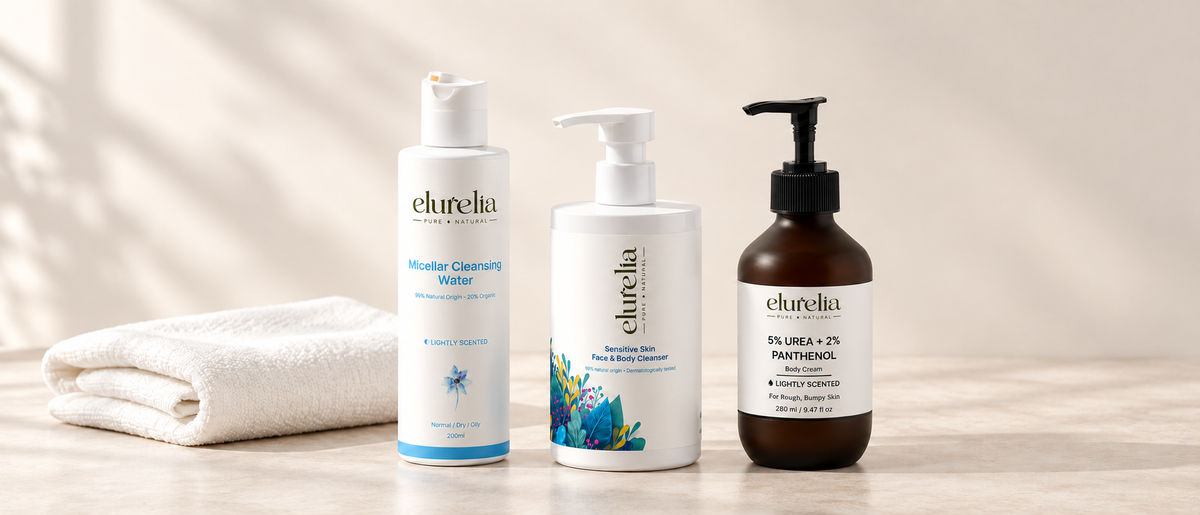
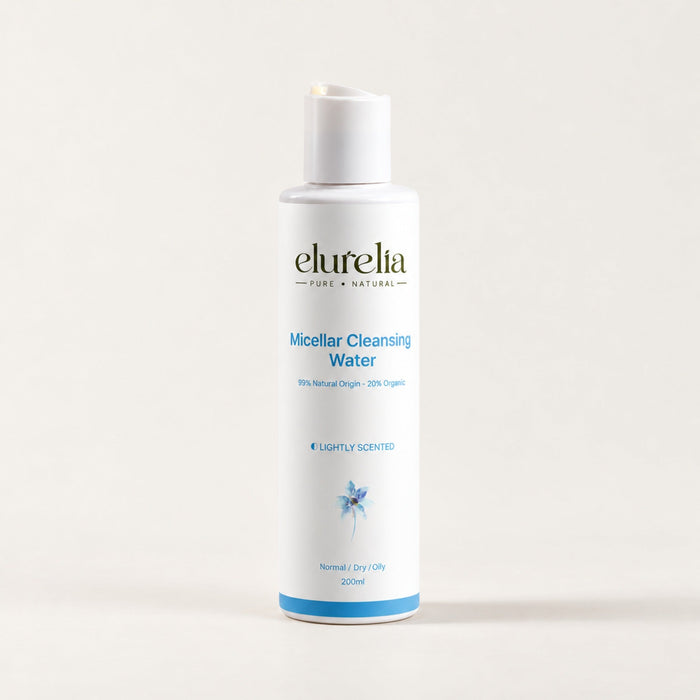
You don't have to rinse. If you prefer no oil trace at all, follow with a mild cleanser such as our Sensitive Skin Face & Body Cleanser or a pad of our Micellar Cleansing Water. This two-step approach is what people call double cleansing.
Take out contact lenses first. If you wear lash extensions, ask your technician before using any oil-based remover, because oils can loosen the glue.
16How long a bottle lasts
Most people use one pad per eye and one for lips, about 2 to 3 ml an evening. Used every evening, a 100 ml bottle lasts around six to eight weeks. If you only remove eye make-up on the days you wear it, it lasts longer.
17Three myths about make-up removal
"Oil makes your skin oily." The light esters in a two-phase remover spread and dissolve make-up; they don't clog pores the way heavy oils might. If you dislike any trace, follow with a rinse-off cleanser.
"Natural means gentle." Plant extracts can irritate too. Camomile is a good example: gentle for most people, a problem for those allergic to the daisy family. Named ingredients let you check.
"Harder rubbing gets it off faster." Holding the pad in place does more than rubbing. Rubbing only adds friction to thin skin.
18Who it suits, and who should skip it
It suits you if you wear waterproof mascara or long-wear make-up; fragrance bothers your eyes or skin; you want to stop rubbing to get make-up off; and you like a remover you can follow with your usual cleanser.
Skip it, or check first, if you are allergic to daisy-family plants; you dislike any oily trace (our Micellar Cleansing Water leaves none); you only wear light make-up, where micellar water may be enough; or you want one product to wash the whole face.
19What it adds up to
This is a fragrance-free, certified-natural two-phase remover with a light plant-derived oil phase and an organic aloe water phase. The way it works is simple chemistry; the evidence for its supporting ingredients is modest; and its biggest advantage is what it leaves out: no fragrance and no declared allergens, close to the eyes, every evening.
The one thing to know before buying is the camomile. For most people it is a non-issue. For people allergic to the daisy family, it is a reason to choose something else, and we would rather tell you that here than have you find out on your eyelids.
20Your questions, answered
How does a biphasic make-up remover work?
It has an oil phase that dissolves make-up and a water phase that refreshes the skin. Shaking mixes them for a few seconds so you get both on the pad.
Does it remove waterproof mascara?
That is what the oil phase is for. Hold a soaked pad on closed eyes for about ten seconds before wiping.
Is it fragrance-free?
Yes. No Parfum, no essential oils and no ingredient from the EU fragrance allergen list.
Is it safe for sensitive eyes?
It is made for the eye area and contains no fragrance. It does contain camomile, from the daisy family, so skip it if you are allergic to that family. Keep it out of the eyes themselves.
Do I need to rinse after a biphasic remover?
No, but you can. A mild cleanser or micellar water removes any oil trace.
Can I use it with contact lenses or lash extensions?
Remove contact lenses first. Ask your lash technician before using any oil-based remover on extensions.
Is it certified?
Yes, COSMOS Natural by Ecocert, with 99% natural origin.
Does the 60-Day Promise apply?
Yes, on your first order, conditions apply. The full terms are on our 60-Day Promise page.
This article is for general information and isn't medical advice. Cosmetic products: all claims describe the appearance and feel of skin.