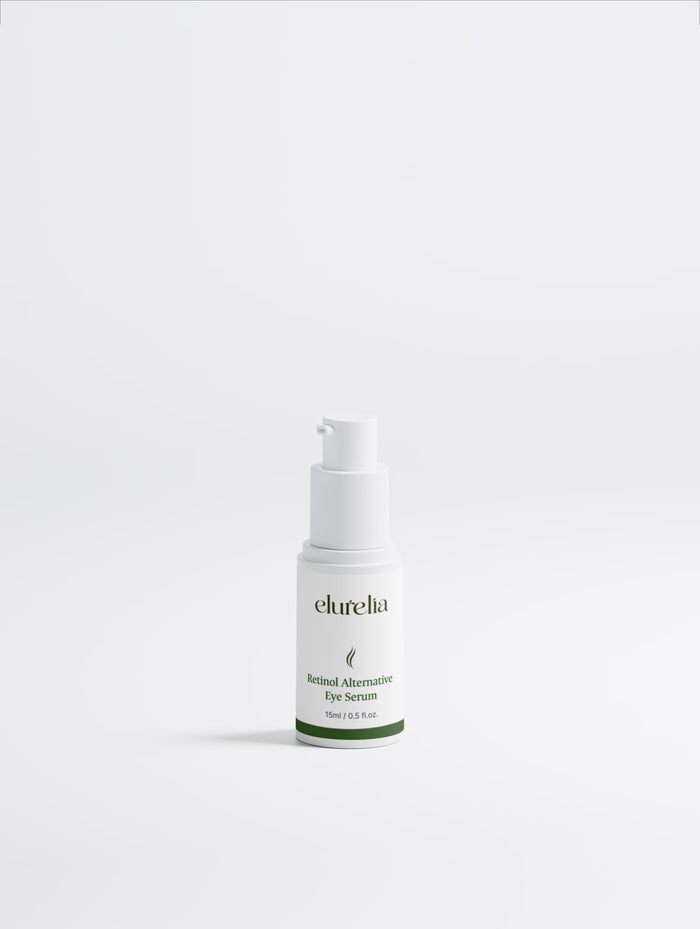
The research behind our Retinol Alternative Eye Serum
Why retinol and the eye area rarely mix, what each ingredient in our eye serum does, what 20 women reported after 8 weeks, and what none of it proves.
Every ingredient discussed here is in the eye serum. The studies tested ingredients at stated strengths, usually in other products, and we say so each time.
Ask anyone who uses retinol where they don't put it, and most will point to their eyes. That's the problem this eye serum exists to solve: the place where fine lines show first is the place retinol is hardest to use.
This guide goes through every active ingredient in our Retinol Alternative Eye Serum, what the research behind each one found, what it doesn't prove, and what 20 women reported after eight weeks with the finished formula. If you only want the product, the eye serum page has everything in one place.
01Why retinol and the eye area rarely mix
The skin around the eyes is among the thinnest on the body, has fewer oil glands and moves constantly. Retinol's familiar side effects, dryness, flaking, redness and stinging, tend to be at their worst there. Many dermatologists advise keeping standard retinol products a little away from the eye area, and many users give up on the eye area altogether.
That leaves a gap. Crow's feet and fine, crêpey lines under the eyes are often the first signs of ageing people notice, and they're exactly where a gentle, twice-daily product is needed. Retinol eye creams exist, usually at lower strengths, but plenty of people still find them too much.
Since November 2025, new face products sold in the EU are also limited to 0.3% retinol equivalent. That's sensible, and it means even strong retinol options are now gentler than they used to be.
02What is a retinol alternative eye serum?
It's an eye product that carries an ingredient chosen to work on the same pathways as retinol, without being vitamin A. Ours uses 2% Bidens Pilosa extract, from a wild herb in the daisy family, in a silky serum built around hydration: aloe, glycerin, sodium PCA and two forms of hyaluronic acid, with horse chestnut extract, borage and jojoba oils.
Because it isn't a retinoid, there's no adjustment period and no need to save it for evenings. You can use it morning and night from the first day, which matters more than strength: consistency is what changes skin.
03Retinol eye cream vs retinol alternative eye serum
| Retinol eye cream | Our retinol alternative eye serum | |
|---|---|---|
| Active | Retinol, a vitamin A derivative | 2% Bidens Pilosa extract, no vitamin A |
| Evidence | Decades of human trials for retinol | Lab studies plus consumer testing on our formula |
| On thin eye skin | Stinging and dryness are common | Designed for twice-daily use |
| When to use | Usually evenings, introduced slowly | Morning, evening, or both |
| EU rules | 0.3% retinol equivalent limit in face products | Not restricted |
| In pregnancy | Generally avoided | No vitamin A; ask your doctor |
Retinol still wins on evidence. If your eye area tolerates it, it's a strong choice, and our retinol guide explains how to use it well. This serum is for everyone else.
04How we rate the evidence
| Label | What it means |
|---|---|
| Human trial | People used it and it was measured, ideally against a comparison and blinded. |
| Consumer testing | People used the finished product and rated their own skin. Real-world, but self-assessed. |
| Review | A summary of earlier studies. |
| Lab | Cells in a dish. Shows mechanism, not results on a face. |
| Maker's data | Tests run or paid for by the company selling the ingredient. |
05Bidens Pilosa, in depth
Bidens Pilosa extract
Evidence: labBidens Pilosa, also called Black Jack, is a wild herb from the daisy family. Its extract contains phytol, which the body can convert into phytanic acid, a compound known to act on RXR receptors, one of the two receptor families retinoids work through.
- Dieamant G. et al. Antiageing mechanisms of a standardized supercritical CO₂ preparation of Black Jack (Bidens pilosa L.) in human fibroblasts and skin fragments. Evid Based Complement Alternat Med, 2015:280529. Read the source
06Hyaluronic acid around the eye
Hyaluronic acid, two forms
Evidence: human trial, around the eyesThis is one of the most relevant studies in the whole guide, because it was done exactly where you'll use this serum.
- Pavicic T. et al. Efficacy of cream-based novel formulations of hyaluronic acid of different molecular weights in anti-wrinkle treatment. J Drugs Dermatol 10(9):990–1000, 2011.
07Horse chestnut and escin
Horse chestnut seed extract
Evidence: small human studyWe go into horse chestnut and escin in more depth in the research behind our Smoothing Eye Cream, where it's the hero ingredient.
- Fujimura T. et al. A horse chestnut extract, which induces contraction forces in fibroblasts, is a potent anti-aging ingredient. J Cosmet Sci 57(5):369–376, 2006. Read the source
08Borage, jojoba and castor oils
Organic borage seed oil
Evidence: reviewBorage seed oil is one of the richest plant sources of gamma-linolenic acid, a fatty acid involved in the skin barrier. A 2017 review of plant oils applied to the skin (Lin, Zhong and Santiago) describes borage oil's anti-inflammatory and barrier-supporting properties across the studies it collected. It's a review of small studies, not a trial of our serum.
Jojoba, sixth on the list and organic, is a liquid wax close to the skin's own oils (Pazyar et al., 2013, a review). Castor seed oil gives the serum its slip and a cushioned feel. Together they keep the eye area comfortable without heaviness.
- Lin T.K., Zhong L., Santiago J.L. Anti-inflammatory and skin barrier repair effects of topical application of some plant oils. Int J Mol Sci 19(1):70, 2017. Read the source
- Pazyar N. et al. Jojoba in dermatology: a succinct review. G Ital Dermatol Venereol 148(6):687–691, 2013.
09Aloe and glycerin
Organic aloe leaf juice and glycerin
Evidence: small human trial + reviewAloe is the first ingredient, so it's the largest single part of the formula. In a two-week study of 20 women (Dal'Belo et al., 2006), creams containing freeze-dried aloe raised the water content of the skin's outer layer. Glycerin, second on the list and made using organic ingredients, is one of the best-evidenced humectants there is; a 2008 review (Fluhr, Darlenski and Surber) summarised its benefits for hydration and barrier function.
Both are covered in more depth in the research behind our serum.
- Dal'Belo S.E. et al. Moisturizing effect of cosmetic formulations containing Aloe vera extract in different concentrations. Skin Res Technol 12(4):241–246, 2006.
- Fluhr J.W., Darlenski R., Surber C. Glycerol and the skin. Br J Dermatol 159(1):23–34, 2008.
10Sodium PCA
Sodium PCA
Evidence: reviewPCA is the largest single part of the skin's natural moisturising factor. A 1981 review (Clar and Fourtanier) found creams with at least 2% PCA or PCA salt improved dry skin. Sodium PCA is seventh in our formula, fairly high for an active. It's an older review, much of it the authors' own work, and our percentage isn't published. There's more in the research behind our moisturiser.
- Clar E.J., Fourtanier A. Pyrrolidone carboxylic acid and the skin. Int J Cosmet Sci 3(3):101–113, 1981.
11The supporting actives
Alteromonas ferment extract
Evidence: lab + maker's volunteer testA marine sugar (exopolysaccharide) that forms a light film on the skin. In a 2017 study by its makers (Borel, Lamarque and Loing, Journal of Cosmetic Science), it reduced UV-linked damage to cell fats in the lab and, at 0.02%, cut the number of fine particles sticking to volunteers' skin by 45% against placebo. We don't know if our grade is the one tested.
Dipalmitoyl hydroxyproline
Evidence: maker's dataAn oil-soluble form of hydroxyproline, an amino acid found in skin, 12th in our formula. Its maker reports firmer-looking skin and fewer visible wrinkles, but hasn't published the study details, and we found no independent peer-reviewed trial. Promising, not proven.
- Borel M., Lamarque E., Loing E. Unique natural exopolysaccharides for biomimetic protective effect against urban pollution. J Cosmet Sci 68(1):126–132, 2017. Read the source
- Seppic. SEPILIFT DPHP (dipalmitoyl hydroxyproline), ingredient information. Read the source
12The light-reflecting pigment
The formula contains CI 77163, bismuth oxychloride, a pure mineral pigment that reflects light. It gives the serum a soft, luminous finish and helps the eye area look brighter and smoother straight away.
We want to be clear about that, because it matters when you read the testing results. Some of the instant visible improvement people report, and some of the brighter look around dark circles, is optical: light bouncing off the skin. That's a genuine cosmetic benefit, and it isn't a change in the skin itself. The hydration and smoothness people noticed over eight weeks are a different, slower effect.
13Testing on this exact formula
Everything above tests single ingredients. The only results for our finished eye serum come from consumer-perception testing: 20 women used it for 8 weeks and rated their own skin.
| Group | What people reported |
|---|---|
| Smoothing & firming | 95% smoother-looking skin · 90% a smoothing effect on tired-looking skin · 80% firmer-looking skin · 60% a lifting sensation |
| Hydration & texture | 90% noticeably more hydrated · 90% improved-looking texture · 85% instantly comforted |
| Dark circles & bags | 90% dark circles looked less visible · 85% under-eye bags looked less visible |
| Radiance & tone | 80% more radiant · 80% visibly brighter · 70% more even tone · 60% blemishes less visible · 55% dark spots less visible |
| Lines | 85% an immediate visible improvement · 70% instant improvement in the eye area · 70% lines looked reduced · 70% lines looked improved · 65% wrinkles looked reduced |
| Overall | 95% an overall improved appearance of the eye area |
Read the pattern. Smoothness and hydration scored highest, which fits the strong evidence for the hydrators. Lines and dark spots scored lowest, which fits the lab-only evidence for Bidens Pilosa and the fact that pigment changes slowly.
14Dark circles and bags, honestly
90% of testers saw their dark circles look less visible and 85% saw under-eye bags look less visible. Those are real perceptions, and we publish them. We also want you to know what's behind them.
Dark circles come from pigment in the skin, blood vessels showing through thin skin, or shadows from the shape of the eye area. Bags usually come from fluid collecting overnight or from the structure of the lower lid. A light-reflecting finish and better hydration make the area look fresher. No cream removes pigment, fluid or structure, and we don't claim this one does. Sleep, daily SPF, treating allergies and, frankly, concealer help too.
15How to choose an eye serum
16How to use it
| Step | Morning | Evening |
|---|---|---|
| 1 | Cleanse | Cleanse, removing makeup |
| 2 | Eye serum: a rice-grain amount | Eye serum: a rice-grain amount |
| 3 | Eye cream, if you use one | Eye cream, if you use one |
| 4 | Moisturiser, then SPF | Moisturiser |
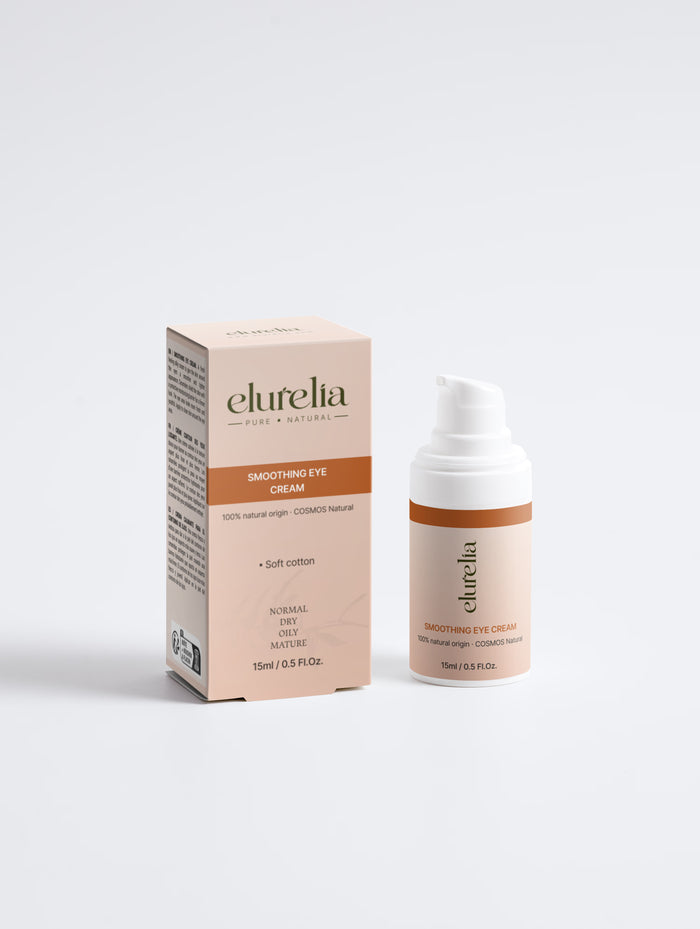
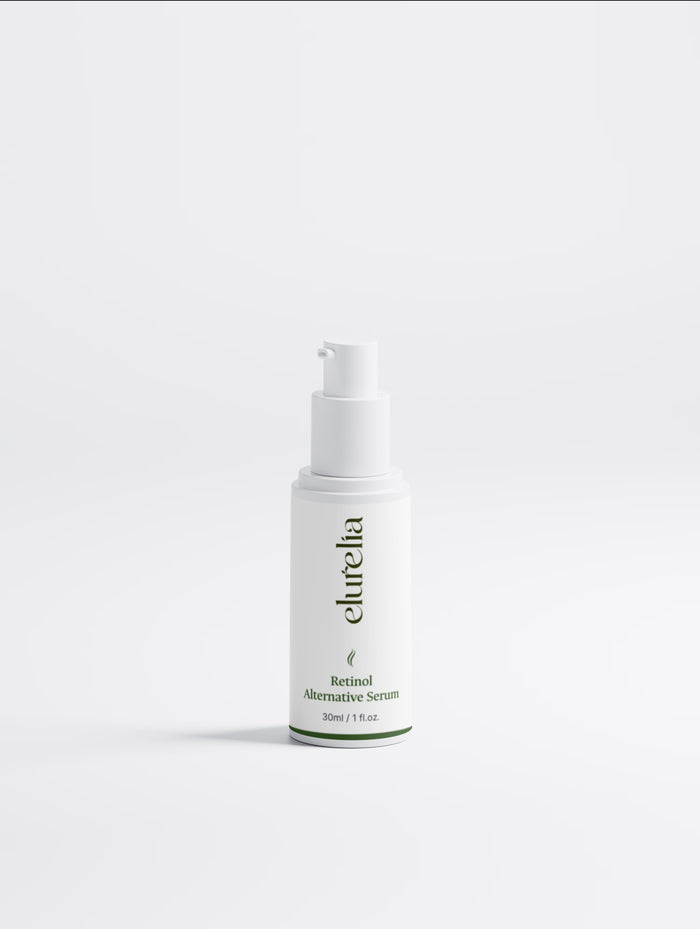
Tap the serum along the bone around each eye with your ring finger, keeping away from the lids and lash line. Follow with our Smoothing Eye Cream if you want extra hydration, and our Retinol Alternative Serum and Moisturiser for the rest of your face. A 15 ml bottle lasts around two to three months used twice a day.
Not sure whether you need the serum, the cream or both? Our eye cream or eye serum guide answers that in a few minutes.
17Who it suits
It suits you if retinol was too harsh for your eye area; you want a retinol alternative you can use morning and night; your eyes look tired, dry or creased by the end of the day; or you want every ingredient named before you buy.
Skip it, or check first, if you need a fragrance-free eye product; you react to ragweed, daisies or chamomile; your eyes are suddenly swollen, itchy or red; you're pregnant or breastfeeding and haven't asked your doctor; or you want the best-evidenced option regardless of comfort, which is retinol. For the plant alternative with human trial data, see bakuchiol vs Bidens Pilosa.
18What it adds up to
This eye serum puts a retinol alternative where retinol is hardest to use. Its hydration evidence was gathered around the eye itself, the finished formula was rated well by 20 women over eight weeks, and we've told you which parts of that result are optical and which are about the skin.
If you want a gentle, twice-daily eye product with a plant retinol alternative and every ingredient on show, this is the one we'd point you to.
19Your questions, answered
What is the best retinol alternative for the eye area?
Bidens Pilosa and bakuchiol are the two plant alternatives with a real scientific case. Bidens Pilosa suits a light serum you can use twice a day; bakuchiol has a human trial against retinol. Neither is vitamin A.
Can I use a retinol alternative eye serum every day?
Yes. It's designed for morning and evening use from the first day, with no adjustment period.
Does an eye serum help dark circles?
In our testing, 90% saw dark circles look less visible, partly thanks to a light-reflecting mineral pigment. No serum removes pigment or shadows.
Can I use the eye serum with an eye cream?
Yes. Apply the serum first, let it settle, then the eye cream.
How long does a 15 ml eye serum last?
Around two to three months used morning and evening at a rice-grain amount.
Is the eye serum fragrance-free?
No. It's lightly scented and declares four allergens: Geraniol, Citronellol, Linalool and Citral.
Does the 60-Day Promise apply?
Yes, on your first order, conditions apply. Use it daily for 60 days, and if your skin hasn't changed the way you hoped, email us between day 60 and day 90 for a refund of the product price.
This article is for general information and isn't medical advice. Cosmetic product: all claims describe the appearance of skin.